

An interview with sundayclub
The Winnipeg-based duo talk unexpectedly making a shoegaze record, the correct way to spell their name, cutting their teeth playing polka music, and how Slowdive changed everything for them.


Shoegaze and dream pop aren’t genres that regularly get called out for producing bona fide earworms. Melodies have always seemed to flow throughout the genre, be it Pale Saints’ “Sight of You,” Ride’s “Twisterella” or even what seems to have become the genre’s biggest anthem, Slowdive’s “When the Sun Hits.” But I love the thought of unabashed pop hooks becoming more of a thing in this genre.
About a year ago I shared my excitement for singer-songwriter [Samira] Winter and her 2025 album, Adult Romantix. That particular album, I wrote, achieved “popgaze” perfection. Winnipeg’s sundayclub make something they call “dreamy, gut-punch pop,” but I’d go so far as to say they too have engineered a sound that is another exquisite case of “popgaze” with their self-titled debut album.
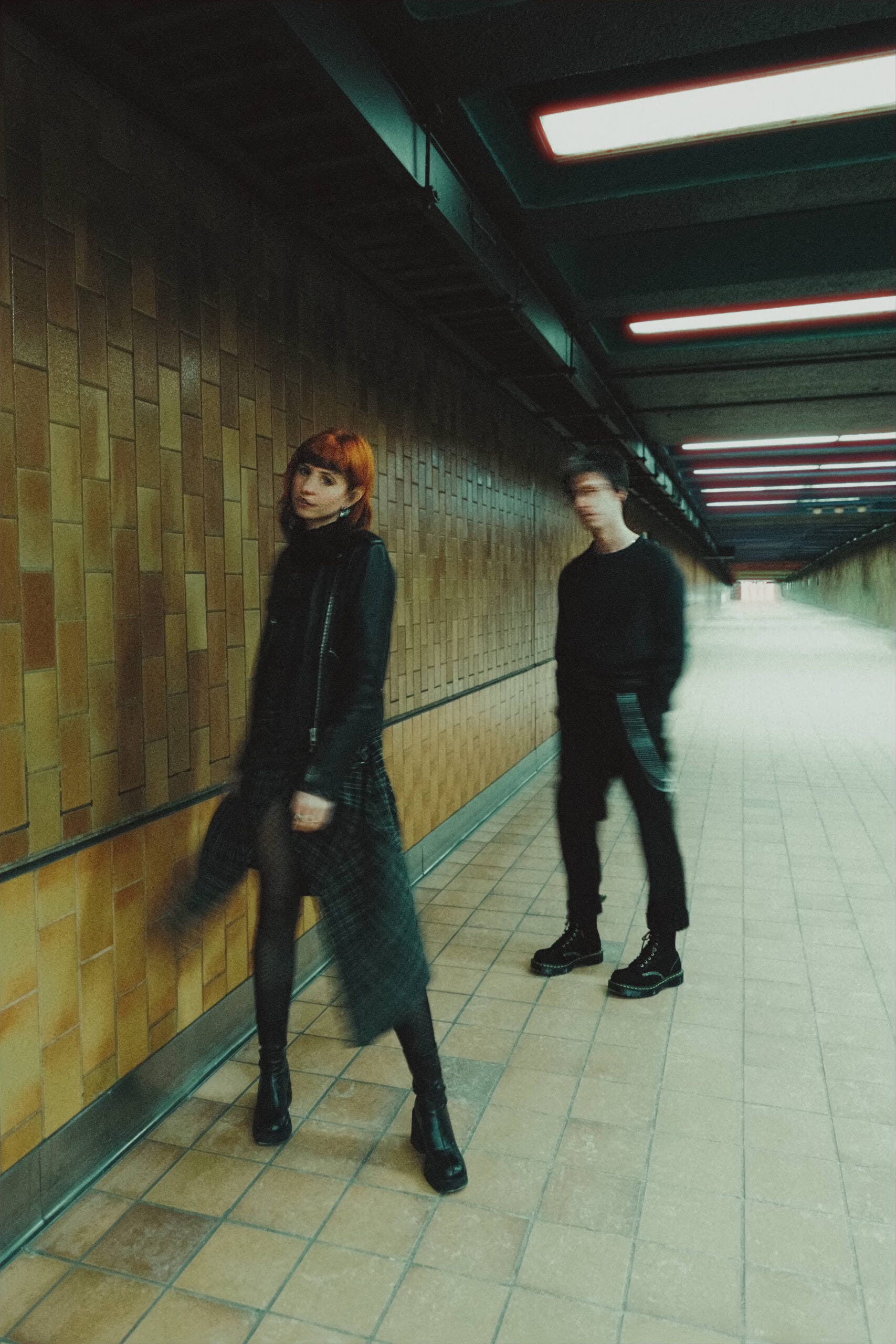
A duo consisting of Courtney Carmichael and Nikki St. Pierre, sundayclub (one word, lowercase) didn’t even set out to become shoegazers. They were just a couple of university students in Manitoba who came together without any real plan. Carmichael grew up playing - of all things - polka music with her family, while St. Pierre’s interests originally lay more in Winnipeg’s punk and metal scene. Yet once they began collaborating, the “indie music” they sought to create blossomed into something completely unexpected.
Their 2025 debut EP, Bannatyne, was textbook dream pop: warm textured production with yearning, angelic vocals and distorted guitars that oozed sapid melodies. Paper Bag Records quickly snapped them up, and in July 2026, released the band’s debut full-length, SUNDAYCLUB. The album is brimming with densely-layered, shoegazy bops that recall the euphoric, sun-kissed hooks and big sonic swings we heard on Alvvays’ Blue Rev and she’s green’s recent Swallowtail.
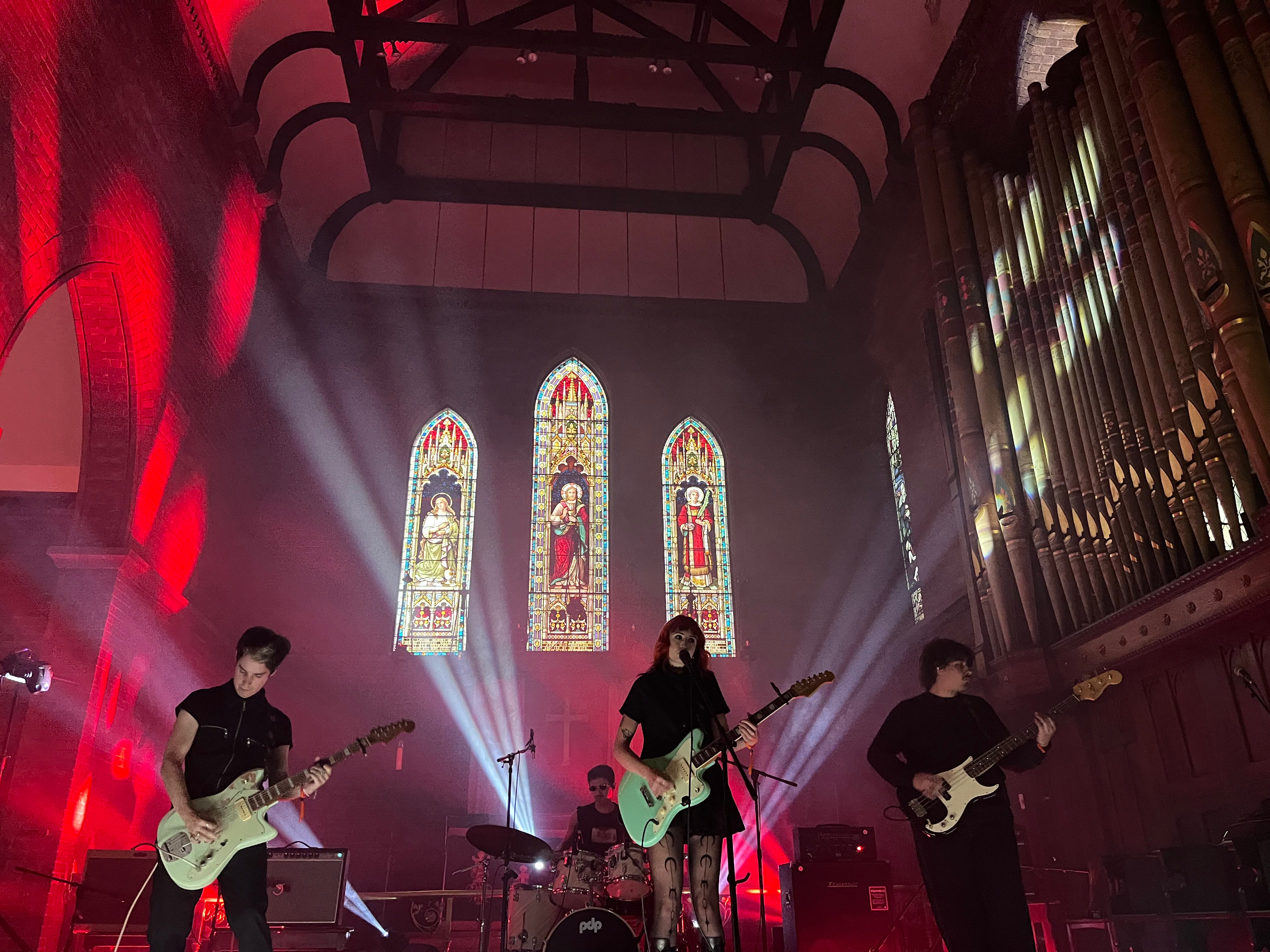
Two weeks after the album’s release, sundayclub took part in this year’s Loveless Festival, a Toronto-based shoegaze weekender organized by Loveless Collective’s founder Ginny Kim, who’s also a member of local shoegazers The Neverminds. Early on a Saturday night, the duo (featuring Edward Bosnjak drums and Gino Vassalloon on bass) commanded the stage of the St. Stephen-in-the-Fields Anglican Church on a Saturday night. Running through a set of album cuts, they quickly transformed the hallowed venue into their own sonic cathedral with their heavenly melodies and ear-splitting volume.
How did you get involved with the Loveless Festival?
Nikki St. Pierre: We were connected with Loveless and Ginny [Kim, founder/organizer/The Neverminds] through Instagram some time last year. We were supposed to play a show together back in the fall, but we flew into Toronto and Court lost her voice entirely. She had laryngitis, and we had to cancel the show. So then we came back a little later, and shot music videos here, and someone on the Loveless team was part of the film crew. They said, “Hey, you guys need to play this.” And Ginny reached out. But then we did this mini tour with The Neverminds as well.
Can I get a quick summary of how sundayclub formed?
Courtney Carmichael: We met in university when my sister and I were looking for someone to produce a couple of demos for the Winnipeg Folk Festival. We wanted to submit some demos to the young performers program, and [Nikki] just happened to be the guy to do it. And then the pandemic happened and we never stopped creating. My sister, unfortunately, stepped aside.
How did you decide to make this kind of music? Because when I hear “folk festival” and then I hear your music, it seems like a mismatch.
NS: We came into this music entirely on our own. We didn’t actually listen to shoegaze until we started to finish this record.
CC: I grew up playing polka music with my uncle and his polka band.
Wait, did you play the accordion?
CC: I played acoustic guitar and occasionally violin, because my family is Ukrainian and very traditionally oriented. Like, “You’re gonna play in your uncle’s band.” So to end up this genre, I guess, it’s sort of happenstance.
NS: I was into metal and punk, and coming from Winnipeg that’s kind of right on the nose. I wanted to go to a Tokio Hotel concert but I ended up by accident at a Tokyo Police Club concert. And that was my first foray into indie music, which kind of brought me into that genre.
That’s funny. Going from polka and metal is a unique path taken to arrive at shoegaze. Talk me through the band’s name and spelling? Where did “sundayclub” come from and why do you spell it as one word in lowercase?
NS: Well, we had played around with a lot of words, and there was something about it that just felt right. Like, on all of our inner cases, it’s engraved differently. At one point, it was, like, “sun/day club” or…
CC: “sun day club.”
NS: But people would always get it wrong. But we really liked how it looks all lowercase, as one word.
CC: People still get it wrong, though. They’ll capitalize the ess. They’ll split up sundayclub and they’ll capitalize the ess and then they’ll capitalize the cee randomly.
Okay, but then you self-titled the album but used all-caps…
CC: Yeah! To try to cement the idea that it is supposed to be all together in uniform. I don’t know, we probably just made things more confusing.
I can see people switching those spellings…
CC: But if they switch them that’s okay. It’s just about the uniform nature of it.
What other names did you consider for your band?
CC: Oh my god, no, they’re all embarrassing.
NS: There was only two in my head when we were going over them. And it was sundayclub and Sorority Boy…
CC: Or Frat Girl. We were switching them around.
NS: But we thought it felt kind of gross or like a Soccer Mommy kind of band, which we’re just not.
What is Winnipeg like as a city to live and play music in?
NS: I would say it’s one of the best places to be and grow as a musician. The community is so, so supportive, where, if you’re just not quite ready to be playing shows or to do anything like that, you’re still gonna get support, just because the community wants to help out.
CC: Yeah, it’s a very welcoming community. So grassroots and small, so everyone really knows each other, and a lot of bands will collaborate. There’s a cohesion in that group for sure. In terms of our sound, I don’t think there’s much in Winnipeg that is quite like us, I don’t think.
The only band I could think of is Living Hour.
CC: Living hour, yeah.
NS: And even then, they’re more slowcore.
CC: Slacker rock... They’re fucking cool.
What is another band from Winnipeg that fans of sundayclub should know about?
CC: That’s a good question. I’m a fan of Slow Leaves. I think Grant [Davidson] is amazing. We’ve played a couple shows and festivals with him. He’s more of a singer-songwriter, like Americana, but his voice is incredible. I’ve never heard anyone sing like him, or write songs like him. His songs are really heartfelt.
I read that there is a Weakerthans connection with the band. I suppose they and Propagandhi are kind of the gods of Winnipeg music. Tell me about that connection?
NS: So we went to a Manitoba music Christmas party, whatever. We show up 15 minutes after it ends, and then we see Stephen Carroll, right? We didn’t really know much about him, aside from he’s the intimidating looking guy on all of the music industry panels. He always has a straight face on everything, he seems very serious. So he knew we were doing a record, and he asked us to send it to him. And we’re like, “Cool, yeah.” So we send it to him, and then he sent it off to Paper Bag Records. And within 15 minutes of that email, it was like, “Get me on the phone with sundayclub.” And then two weeks later, he flew up to see us, and that’s when I found out that he was in The Weakerthans! I had no idea.
CC: We didn’t actually know, because he very humble and down to earth. He did offer that he was gonna give us one of his shirts. He still hasn’t! I want a Weakerthans shirt.
You mentioned that towards the end of making the album, you were just getting into shoegaze? Was there a band or album that drew you into this kind of music?
Both: Slowdive.
NS: My hot take is that they’re self-titled album is their best. That’s my hot take.
CC: My hot take is, well, it’s not a hot take, but I think a lot of people have said this, like critics and scholars, or whatever, have said that Slowdive are the only true shoegaze band.
So you had written the album and were recording it, but then realized that the music you were making was kinda shoegaze, kinda dream pop. Was it just a matter of hearing Slowdive that you learned that the music you were playing was part of this genre?
CC: Honestly, it wasn’t until the press started writing about it... Like when we were signed, they weren’t saying, “Oh, you guys really do shoegaze.” I actually think what we had made was genreless, if that’s even a thing, until the press started writing more about it. Which is funny. It’s like this retroactive thing. I think if you go back on my Instagram, my personal Instagram, I have a picture of Rachel [Goswell] that I had posted in about 2021. And so we were dabbling...
NS: Well, when you did that, I was like, you barely listen to Slowdive.
CC: Yeah, he was like, “This is so poser of you! You don’t don’t really listen to that band.” But I would say it wasn’t until 2025, when the record was done, that we really dove in to Slowdive and Cocteau Twins, a lot more of that dreamy, hazy music.
So what are your influences if it wasn’t that kind of music?
NS: I listen to a lot of Metric, Alvvays, Surf Rock is Dead.
CC: I was listening to Snail Mail at the time, and Clairo. Day Wave is and was a big influence. Jackson Phillips, that’s Day Wave, anything he touches sounds like him.
NS: It’s not what we were trying to make something else. We didn’t really know what we were trying to make. We spent a lot of time chasing our tails and remaking the record again and again and again. We stopped listening to music for about six months, when we hit the mixing floor. And then we remade the record while mixing it. But without any other influences creeping in.
CC: We had to isolate ourselves and shut everything off.
What are the pros and cons of operating as a duo?
CC: That’s a great question.
NS: We have a drummer and a bassist who tour with us, but in the studio a pro is that communication is really easy. There’s no third opinion and if the other person feels strongly about something, it’s pretty easy to convince the other person. There’s no ganging up on someone. So it keeps everything very fair. But we’re on the same page so much that we don’t really have that issue anyway.
CC: A con is getting on each other’s nerves, big time. Sometimes two people feels like 20, you know? Even if it’s just one other person, but yeah, that’s where the intro from “Camera Shy” comes in. When I say, “Are you okay?” That was me legit saying, “Can you stop pissing me off?”
NS: “Can you just sing better?”
CC: He was frustrated with me because I wasn’t hitting the notes or whatever. This came at a point where I had done so many takes for this damn song. I was just trying to make it through, and he said, “Are you okay?” And I said, “We’re keeping that.”

What I like so much about the album is how musically, sonically, it sounds very much like shoegaze, and yet, it has this very strong sense of melody. It’s as much pop music as it is anything. Are pop hooks something you work at or does it come naturally to you?
NS: It comes naturally to Court and very unnaturally to me, which is why we make such a good team. All of my melodies suck, and they’re so predictable. Harmonies are good though.
CC: I don’t know. I haven’t really thought of it, but I guess I’m just in love with melody in general. I think anybody that I listen to, be it growing up or even now, the melody’s always there. And if it doesn’t come from the vocals, it comes from somewhere else. So I think that is probably why Slowdive is on such heavy rotation. Because even if they’re singing something that’s sort of monotone, like both Neil and Rachel singing the same thing but an octave gown and up from each other, the guitars are making that melody.
I really like how summery this album is. I guess “Sad Summer” is an obvious example. But I was listening to the album on a walk the other day and it really captures the warmth and spirit of the season. How does a band from a city so renowned for its harsh winters create music that suggests the polar opposite?
CC: Good question. I have no idea.
NS: I wish I had an answer for you.
CC: I don’t think we thought it was summery.
NS: I couldn’t put my finger on it at all. I just kind of made it. We just kind of made the record that we made.
CC: I actually thought it had a darker, more winter and fall vibe.
NS: I thought you were crazy when you said that. It sounds pretty happy.
CC: Some songs are happy. More upbeat, I should say. We made a lot of the record in the dead of winter because there’s nothing else to do. And then in the summer we struggled to write in the summer and lock ourselves away because it is so short, that period of nice weather. “Sad Summer” is sort of about that, the pressure of having to split yourself in two where you’re like, “I really want to just be outside and enjoy this weather. I really just want to go out with my friends, but I have this responsibility to also be writing and creating. Even though I should be able to do both, right?” But you’re just not able to split yourself in two.
What album is played most when the band is hanging out together or on tour?
NS: It changes every tour, but I listened to Slowdive’s self-titled record on repeat all the way to Europe. I fell asleep to it, and I kept listening and woke up to it.
CC: Yeah, Slowdive on tour, yeah, for sure. For me, anything by Alvvays. I’ve been listening a lot to their first record still just because it’s raw and sort of imperfect.
When I first heard your record Alvvays was the first band I thought of as a comparison. What is an activity the band does together outside of music?
CC: Bike rides.
NS: Bike rides, yeah. That’s the only one.
CC: We love a good bike ride. Except we’ve been having trouble lately with tires popping in the middle of riding. We’re gonna have to do some work on those bikes.
What are most of your lyrics about?
CC: This obsessive voice in my head that just never stops. It just never goes quiet. In need of constant validation or vulnerability. And a lot of it is drawn from the music. I pull a lot of emotion from what Nikki plays. And it always just seems to lead into this really melancholy feeling. Even if it’s not something I’m experiencing directly in the moment, I’m able to reach back into the past and remember feeling it. That’s what I’m feeling right now, so I’m gonna talk about it.
If you had to pick only one subgenre listed on your Bandcamp page to describe your music which would it be?
CC: Oh my God. We try to make up these BS genres so that it can encompass what kind of music we might make. So we’ll call ourselves “dreamy, gut punch pop,” and that’s our Instagram bio because that was something a writer had called us in an article and we loved it. I don’t know. Dreamgaze? We sometimes say just shoegaze-adjacent.
Photos by Evie Maynes. Live photo by yours truly.