

An interview with Southpacific
The Ottawa-Toronto trio discuss their return to the stage, reissuing and relearning their catalogue, getting called shoegaze in 2025, and what the future holds for them.

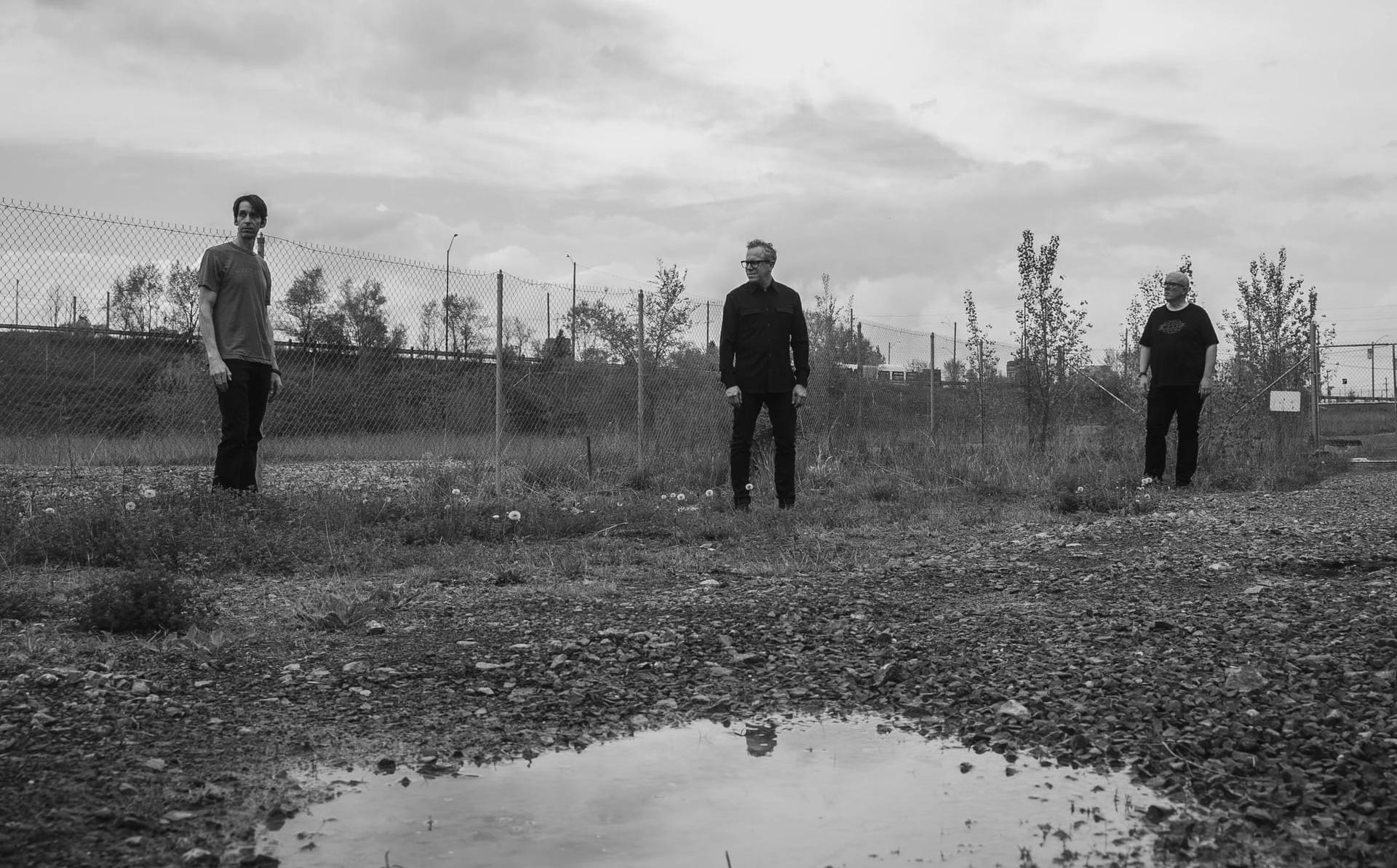
When I began university at Carleton in Ottawa in the late 1990s, I had hopes that the capital city would be able to satiate my appetite for concerts. While I knew Ottawa was never going to match the abundance of shows I saw in Toronto up to that point, I figured it would offer enough to keep me happy, seeing as it was a metropolis. Because Ottawa had a decent track record coming into 1997, when I began my freshman year.
Over the years venues like Zaphod Beeblebrox, Barrymore’s Music Hall and the Dominion Tavern had hosted some of the greatest bands of all time, like Black Flag, Jane’s Addiction, Royal Trux, The Flaming Lips, R.E.M., Yo La Tengo, The Replacements, Radiohead, The Wedding Present, and The Afghan Whigs. Not to mention my favourite Canadian bands of the decade: Sloan, Thrush Hermit, Eric’s Trip, The Hardship Post, Jale, Pluto and Pure. Heck, even my own school’s concert venue, Porter Hall, brought in bands as great as Fugazi, Ramones, Helmet, Redd Kross, Body Count, Alice In Chains, Ministry, The Charlatans, Failure and Tool.
Of course, that wasn’t my experience. In my years at Carleton, I can literally count on my one hand the number of notable concerts I attended: Portishead, Thrush Hermit, Godspeed You Black Emperor!, Hefner and local favourites, Southpacific. (I narrowly missed out on seeing Swervedriver, Fugazi, Guided By Voices and Suede, all of whom performed either just before school started or after it ended.)
That Southpacific gig was such an important one for me because they were one of the only bands from Ottawa that had anything to offer me (Kepler, being the other). I knew there were local scenes for people who liked punk and clubbing, but I never found one for my indie tastes. But I did my part, pitching a feature on them to my school paper The Charlatan, just as they were about to release their first album, Constance, a follow-up to their excellent EP 33. (The article remains to be the only one I’ve ever written where the publication commissioned an illustrated caricature of the artist because there were no press photos. Still funny after all these years! See it below.)
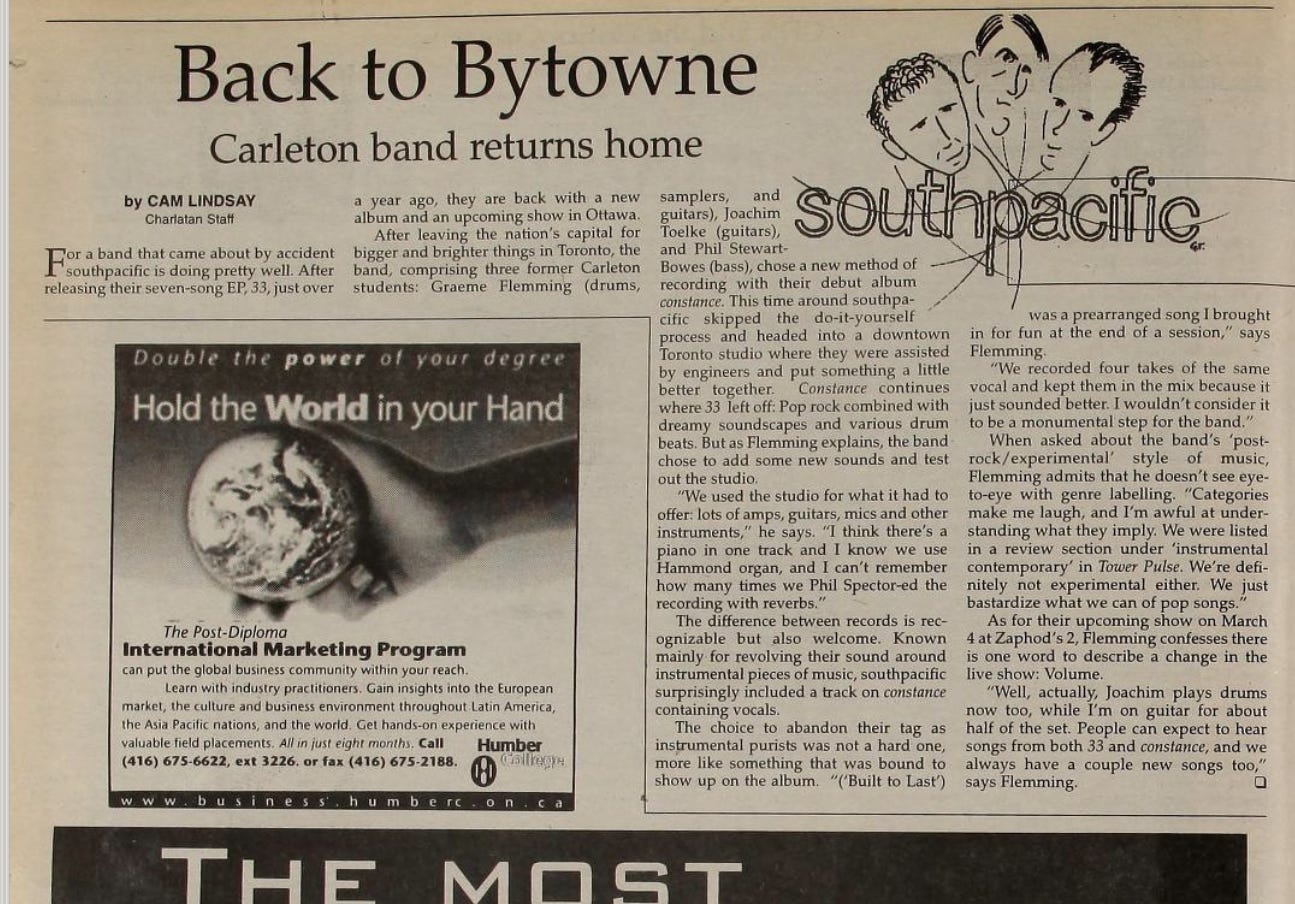
The thing about Southpacific though is that they weren’t just some well-kept secret in Ottawa. The band - Graeme Fleming (drums), Phil Stewart-Bowes (bass) and Joachim Toelke (guitar) - had moved to Toronto by the time they released Constance, which was released by Turnbuckle Records, a New York City-based label that had put itself on the map putting out music by Bailter Space and Oneida. Southpacific had also gained a following through their “unmapped” instrumental music that traversed the sounds of shoegaze, space-rock, drone, ambient, slowcore, and post-rock. They didn't leave themselves open to any genre, and were all the more fascinating for it.
Unfortunately, the band didn’t survive the year 2000. Toelke and Fleming each pursued solo projects, like Frihavn and The Sawfly Skies, respectively, while all three members found careers outside of music. But they stayed in touch, and even continued to jam every now and then. Southpacific meanwhile, found new fans through online forums like Reddit and getting added to playlists on streaming services. To everyone’s surprise, they appeared out of nowhere in 2020 with “Depths,” their first new track in 20 years, which was followed three years later by the EP Radar Road. (Toelke also splits his time with another instrumental post-rock outfit Kosmavermo.)
Now 25 years after the release of Constance, Southpacific are treating their one and only LP to a much-needed vinyl reissue, along with a number of gigs to commemorate the occasion, starting in Trois Rivieres, QC at the Café-Bar Zénob on September 12.
What was the impetus for playing live shows after 25 years? Unfinished business?...
Graeme Fleming: I would say so. We had been considering this for some time. The anniversary of the release of Constance added a deadline to the idea, but we are able to make it work with our respective family lives and commitments, which isn't easy at our ages. We thought it was worth a shot to see how it goes. Perhaps a younger audience keen on the so-called Shoegaze revival impacted things. We're not sure if we'll see our original fans or a new generation this time.
Phil Stewart-Bowes: Personally I’ve been aware of the approaching anniversary, and felt that we shouldn’t let it pass us by without recognizing it in some significant way. Over the years, we’ve receive very gracious messages from fans of our music, and we wanted to do something to recognize that, and bring life to our music again.
How have you found dusting off the old material during rehearsal?
Graeme: Depends on who you ask. I had been away from drums for 25 years. It's not exactly like riding a bike, but we found ways to add to our show this time.
Joachim Toelke: It's been interesting trying to dig through old notebooks and figure out pedal settings, pedal/effect/amplifier routing (which was always changing) and how to actually play the songs.
I listened to Constance a lot to relearn/confirm some parts. I hadn't listened to it in years, and for the first time started to really hear and appreciate the extra tracks, textures and production tricks Graeme put into it. Back during the recording sessions, I mostly focused on my guitar parts and sounds. But meanwhile he was putting everything together and layering and weaving all kinds of other parts and effects into the final album. He was able to be creative and experiment with the collaboration of sound engineer Nick Holmes. I think Holmes was excited to be able to be creative too and try different recording techniques.
Graeme had lost his notes and the tuning for "A Better Life Since"- which was one of the songs he brought in to the recording rather last minute as we had extra studio time booked and wanted more material for the album. I don't think he had played it since, yet he managed to reverse engineer it recently with some effort by rediscovering the tuning he used- pretty impressive!
I used to use one of those green Line 6 delay pedals (the DL4). For the song “Parallel Lines”, there's a reverse delay effect on the main guitar- it's kind of a unique sound that just really worked when we came up with that. I dusted off the pedal which had been in storage for 25 years and the sound was still saved in the presets! That was an amusing "genie in a bottle" or rather "magic effect in an old pedal" sort of moment.
Phil: It’s been a really great experience playing with the guys again, re-learning the older songs and prepping newer songs to play as well. We’ve made minor tweaks to some of our songs here and there as well, just to add a little twist. Overall I think we are sounding as good as we ever have live.
You've announced a handful of shows within driving distance. Is there a plan to play more shows in the future?
Graeme: At this point no but we'll see. We're open to the possibility.
Joachim: It would be nice to play some dates in the US and in Europe next year, where there seems to be some interest. We're curious what the response to these first shows is, and how we feel about them afterwards.
The band actually got back together in 2020 and put out an EP in 2023. What kind of expectations have you set for the band? Any more recording planned?
Graeme: Radar Road was a very different recording experience for us. Covid played with that, along with collaborating remotely. We stepped away after the recording but after some time - I think it was when Phil was visiting me - we listened to it again and agreed it had to be heard. We didn't promote it at all however. So expectations would be to enjoy the live experience. That was a big part of our song making process. We never set goals and probably should, but we know that if we're doing something special it's worth it.
What caused Southpacific to break up in the first place?
Graeme: I guess it would be when I decided to leave. I have some regrets and perhaps it would have been better to take a break. We were getting a lot of publicity that you don't want to waste but I felt something was missing. The guys know how I felt. Some of the material I had been working on was assimilated into Constance. That said, I felt I needed to step away for a bit. We then split into our separate ways after that.
Joachim: When we split up, maybe Graeme was most decisive about it, but we were all a bit stressed and fed up with some aspects of being in a band; with hindsight, we were probably guilty of taking things for granted. We were in a fortunate situation being able to play our music for people who appreciated it. I should have tried harder to connect with where Graeme's mindset was at.
I think usually when you start out with a band, it's creative, and fun and rewarding, and with the right people, collaboration can come easily; everything is exciting. But later on, there are more commitments and obligations, and the less fun parts of being in a band can start taking over.
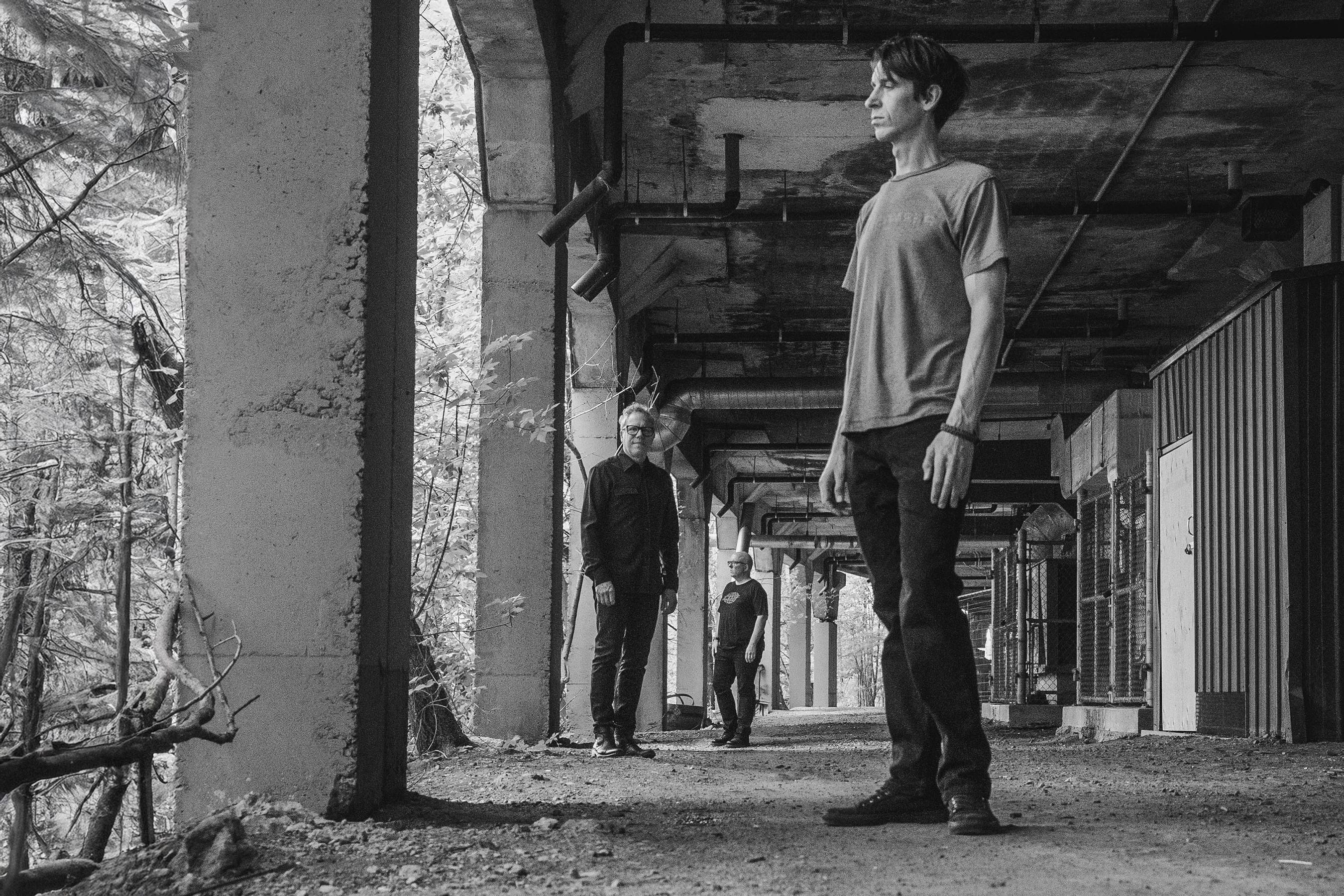
What was it like for the three of you to get back together in 2020, after 20 years?
Graeme: There's a special feeling to hear us come back together after all that time and sound great as if it were just yesterday. Lots of emotions: we're older but we never lost the drive.
Joachim: With our personalities, we have a certain chemistry together that when we're all aligned, it's really special. We've remained friends in the years after the split, so it was nice to meet up, play music again and hear what we could do.
Phil: It was also a great experience to work on new songs in 2019 that became the Radar Road EP. I think we were able to evolve the sound of the band with those songs.
The song “Radar Road” is actually from a demo that Graeme had recorded maybe ten or so years prior, originally called “3 piece” appropriately enough. He had done a specific mix of it that he gave to me and I absolutely loved it. I’d always wanted to record a version of it, which I think was also Graeme’s intention when he recorded the demo.
How would you say things have changed for the band in 2025 compared to during your original run? Have your tastes or influences changed much when it comes to writing new music?
Graeme: I think our tastes have distanced a bit. Southpacific is a common ground. I found myself listening more to 50+ year-old album oriented music - contemporary classical and jazz - and that naturally shifted how I thought about music. Instead of writing on guitar the way I used to, I spent more time exploring sound, mixing and production. It wasn't so much stepping away from songwriting as it was about approaching music from a different angle.
Joachim: Phil lives in [Toronto], and Graeme and I are really far apart on opposite outskirts of [Ottawa], so meeting up is a challenge. Being a remote band now means working on ideas on our own and sending ideas back and forth rather than being spontaneous together. It means intense weekend music sessions where we power through things for hours on end to make use of our time together. Very different than meeting up once or twice a week and evolving things gradually like in the earlier days.
Phil: In terms of influences, what we each listen to evolves over time. I’m always seeking out and listening to new bands and artists. I listen to a lot of electronic and also ambient music, not necessarily sounds you would associate with our band. I think it all filters down in some way or another, though we’ve never tried to emulate the sound of another artist. The sound of Southpacific is the three of us with quite different influences, playing together.
I've read that the band also went by "SoPac" - was that actually a name you acknowledged?
Graeme: Amongst our friends yes, but no.
Phil: “SoPac” is just more efficient!
What made you decide to release Constance on vinyl? Do you think 33 and Radar Road could also get vinyl releases?
Graeme: We had been considering it for the 20th anniversary but couldn't pull the trigger. It's a special record for us so it deserved a special pressing. My cousin Jacob Bryce handled the art work and did a remarkable job seeing that we didn't have the original files from the CD sleeve. The double vinyl package is really beautiful. Of course it would be great if we can do something similar for 33 and Radar Road. I can see that happening.
Phil: I’ve always been a music collector, and I’ve become an avid vinyl collector the last few years. To date we’d only ever released 33 and Constance on CD. We’ve heard the requests over the years for a vinyl release, and I wanted us to make that happen as well. As Graeme said, Jake did a fantastic job on the vinyl sleeve, it’s faithful to the original CD design but also updated for 2025. It was the major hurdle to figure out in prepping a vinyl release, and he made it so easy for us in the end.
We would love to give similar treatment to 3 and Radar Road. Hopefully we will take that opportunity.
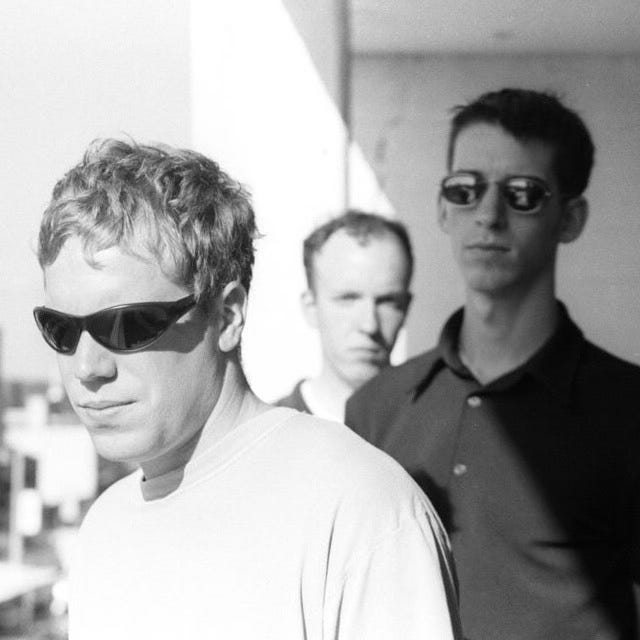
I don't think Southpacific originally identified as shoegaze but it appears you've been claimed as such by shoegaze fans. What are your thoughts on Southpacific being shoegazers?
Graeme: It's fine. It helps when people ask what you sound like. I used to say things just to confuse people when I was asked that hated question, "What kind of music do you play?" “Shoegaze.” That usually gets a "huh?" but it took a fraction of the effort.
Joachim: We were influenced by a lot of retro shoegaze, and especially the spirit of it. I think there was a sense of doing your own thing, not worrying about following any rules about it, and that whole psychological/emotional escapism aspect.
We've also been called space-rock and post-rock, and described at times as ambient, psychedelic and Pink Floyd-y, depending on the song and who you ask.
Phil: It doesn’t bother me either. In the end a genre label is just a shorthand for describing the sound of a band. It just makes communicating about music easier.
It’s interesting being considered as a “shoegaze” band in 2025. When we were first active in 1998, it was a few years after the original early ‘90s heyday, so we stood out for having a sound different than most other bands of that time. Now, there are seemingly thousands of new shoegaze bands, so I think it can be difficult to stand out from the pack if you aren’t doing something a little different to distinguish yourselves.
Did you feel like you were part of any scene back in the late '90s, be it post-rock, space-rock or even the local scene in Ottawa?
Graeme: I don't think we lasted long enough honestly. Yeah, there were a handful of bands we befriended who were listening to music we liked as well. They were gigging and kindly accepted us into their shows or rehearsal spaces. That would be the extent of the scene though from a standpoint of bands we associated with. We weren't a very polished band. Between Ottawa, Toronto and the Canadian tour we played it was under 25 shows. Being instrumental, we could have been lumped in with some other bands at the time but I think we were our own thing.
I grew up in Hamilton and got to know the guys in Tristan Psionic. What do you remember touring across Canada with them in 2000?
Graeme: Fantastic guys. Very down to earth and talented musicians - they played double duty backing up Eric Bachmann's set. They accepted us on the tour as a late addition I recall and made us feel very welcome. Eric was a lot of fun to be around as well. I still have fond memories.
Joachim: Getting to spend time with them was great - they were also supportive and full of advice. One of the best parts of being involved in music is the various interesting, kind, and creative people you get to meet.
Phil: I have very fond memories of that tour as well, and specifically of all the guys in Tristan Psionic and Eric Bachmann as well. They also brought with them their friend Bobby, who was the bassist in Scottish band Deckard, later re-named as Baby Chaos - we had a great time hanging out with him. The whole group of us got along really well that whole tour. I’ll never forget that time.
Thank you for this! Underrated band hopefully getting the recognition
they have earned.