

An interview with Should
Marc Ostermeier talks about the new reissue of Should's 'Feed Like Fishes', why he made guitar music without actual guitars, and learning he'd made a classic shoegaze album - 25 years later.

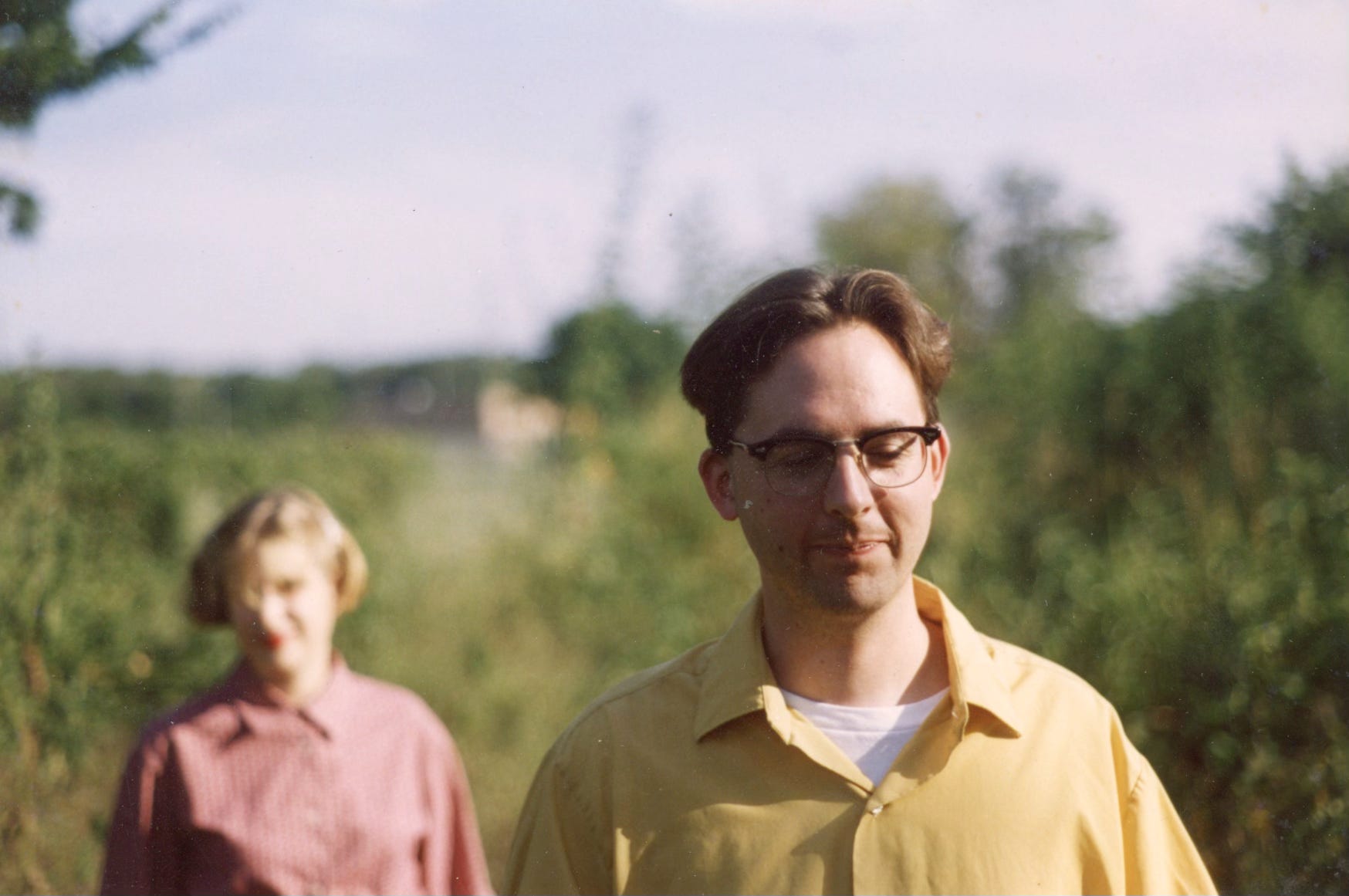
Timing is apparently everything, but that’s never been the case for Should. Originally formed in the early 1990s by Marc Ostermeier, then a student at the University of Texas in Austin, Should, or shiFt as he originally called it, was an ambitious project designed to test his abilities at making the music he was listening to at the time: shoegaze (then in its first wave).
Using an 8-track recorder, Ostermeier, with help from his brother Eric and friend Tanya Maus, used unconventional techniques to create his own walls of sound in his bedroom. As he described on his label’s website, “Songs were built around guitar phrases recorded onto cassette that were then sampled and looped using an Ensoniq EPS sampler. An overloaded 4-channel mixer was the primary source of disortion.”
From these intimate sessions came 1992’s The Saints Have All Indifference and 1993’s Resonate cassette (Whirlingpool), followed by the mini-album A Folding Sieve (ND) in 1994. While the approach was minimalistic and rather bare, Should, as they would later be called, pulled off these miracle little budget symphonies that rivalled the professionally-recorded works he took inspiration from.
In 1998, Should released what many would consider their magnum opus, their debut full-length Feed Like Fishes. Not as indebted to shoegaze as A Folding Sieve, Feed Like Fishes saw Ostermeier attempt more measured and controlled techniques, eschewing his unique style of sampling for an actual guitar. While it does feature a sparkling cover of The Wedding Present’s “Spangle,” the album used a framework closer to the minimal attitude of slowcore and the boundless experiments of post-rock. Mostly ditching his earlier fascination with shoegaze, as the label puts it, he instead decided on “4 sides of minimal pop songs that favor restraint over release, atmosphere over gesture.”
While Ostermeier would continue to modify the sound of Should’s music over the years, Feed Like Fishes, began to earn itself a cult status, developing an audience through a variety of channels. A vinyl reissue of A Folding Sieve (as well as a cassette re-release of Resonate) by Captured Tracks in 2011 as part of the label’s Shoegaze Archives series helped introduce Should to a whole new generation of fans.
After months of teasing it, now comes a long-awaited vinyl reissue of Feed Like Fishes from the wonderful folks at The Numero Group, who continue to unearth and dust off out-of-print treasures. The expanded edition includes a bonus disc of material from the same period that reveal Ostermeier’s shoegaze era was still alive and kicking. Rather than a Feed Like Fishes companion, the ten tracks serve as complete and brand new Should album that will no doubt delight shoegazers yearning for their next great fixation.
What is the story behind the name change from shiFt to Should?
Marc Ostermeier: In 1997, a major label sent us a “cease and desist” letter demanding that we stop using the name shiFt. The label was about to release an album by another band named Shift. However, we had been using the name for several more years so we replied with our own “cease and desist” letter documenting how we held the right to the trademark. The label then offered us a hefty sum to give up the rights. We counter-offered, and they capitulated. As for why I chose “Should”, I wanted an atypical name that meant almost nothing.
You had already released some recordings, including A Folding Sieve, under the name shiFt. From what I can tell it was still early days for you, but how much of a hindrance was that for you?
I figured we had so little name recognition that the name change wouldn’t matter that much in the long run. The fact that we didn’t play live anymore was likely more of a hindrance to getting noticed, in retrospect.
From what I read, you didn’t actually buy a guitar until after you’d recorded A Folding Sieve. Beforehand you were just sampling guitars. Was that always the plan? What made you sample guitars instead of playing one?
Yes, that’s correct. I’d been making music under the name shiFt for about five years before I started recording what would be A Folding Sieve. It was all performed on keyboards. When I started graduate school in 1990 (at University of Texas - Austin), I bought an Ensoniq EPS sampling keyboard. It was an early workstation in that it had a 8-track sequencer and you could have eight instruments online at once, which could be routed to eight separate outputs (i.e. you could put different effects on different sounds). I also bought a Fostex 8-track reel-to-reel tape recorder.
The music I was making pre-A Folding Sieve had no guitars. I’d started to get into shoegaze music with bands like My Bloody Valentine, Slowdive, Pale Saints, Medicine, and The Boo Radleys. But when I heard the Lilys’ In the Presence of Nothing something just clicked, and I thought I could do something like that, but with layered sampled guitar phrases. As I couldn’t play guitar in the traditional sense, it was a quicker route to explore making music in this style. As I was generally pleased with the initial results, I kept doing it for a while. But I eventually found the process too limiting.
How you were writing and recording wasn’t exactly conventional. Were you just figuring it out by yourself and that’s how it unfolded or were you interested in challenging yourself to do things differently?
I was just figuring out a way to make the music I wanted to play without waiting for me to gain the technical ability to play the guitar. To start with, I sampled a few guitar snippets from some parts my brother Eric had recorded for music he was working on. I also borrowed his guitar and recorded to cassette some very simple guitar phrases. I picked the best parts, sampled them, and started playing around with what I could do with those. I found I could get very interesting distortion running those guitar samples too hot through an old mixing board and some rackmount effects units.
Should first began as a solo project. How did Eric get involved? Was that collaboration more out of convenience because he was your brother or did the two of you just have similar interests/tastes?
We have very similar interests in music (he was the one who first turned me on to shoegaze). So we would talk about music all the time. But we didn’t live in the same state. By Fall 1992 he was in law school at Michigan, and I was in Austin. His contribution to A Folding Sieve was a couple of the guitar samples I took from music he recorded. But he did come to Austin for a couple of summers, and we did create music together. Some of it appears on Feed Like Fishes. He wrote and performed the guitar and bass parts of “Faded”. “Inst2” is built around his delayed guitar. He wrote his bass part to “In Nine” after I told him I was not happy with my own. Later, after I’d moved to State College, PA he visited and we built “Lullen” around his guitar part and “Memdrive” around his bass.
What made you begin collaborating with Tanya? What did she bring to Should’s music?
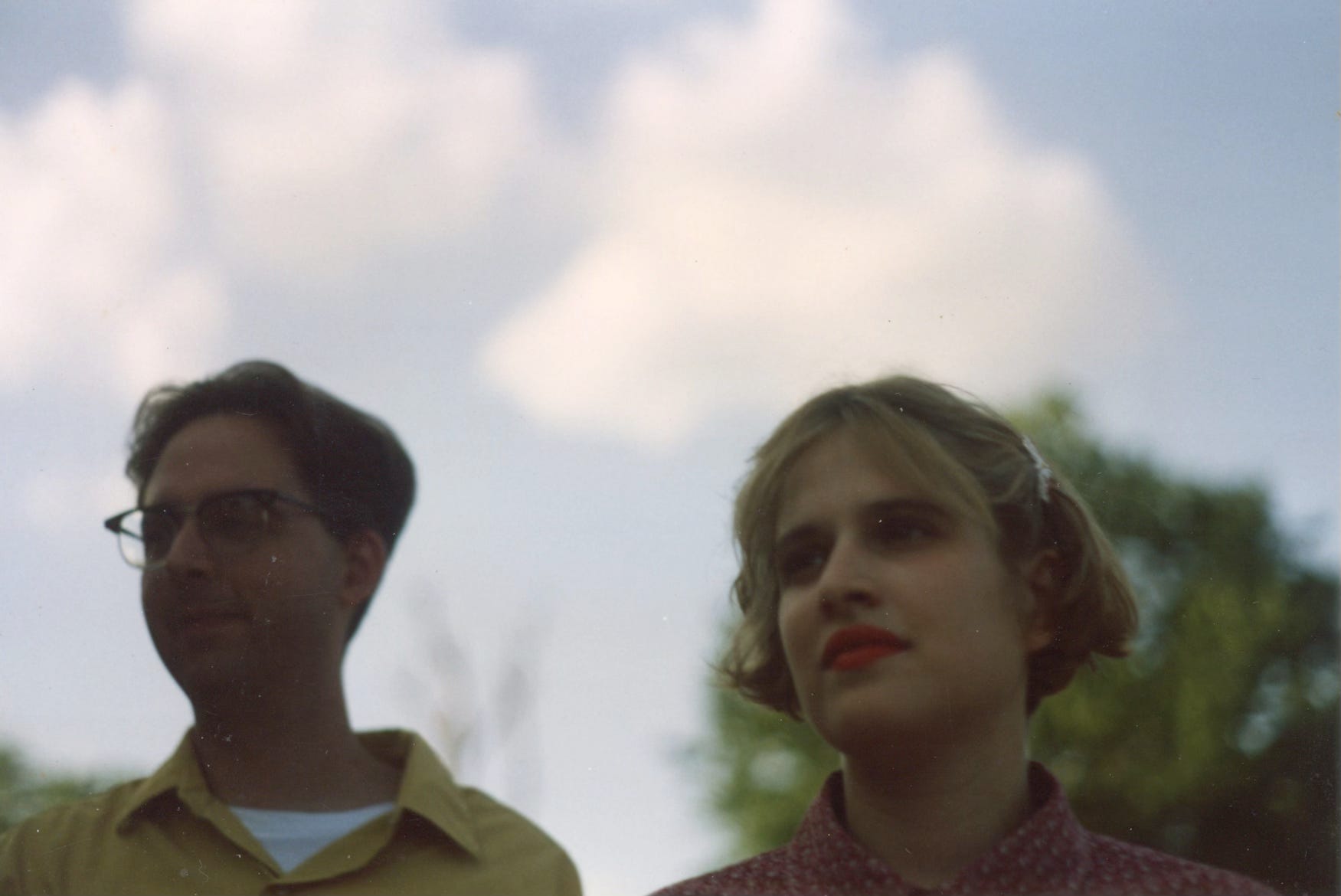
I’ve always liked the pairing of male and female vocals. Tanya was my wife’s friend from high school. She was the maid of honour at our wedding in 1992 and soon afterwards moved to Austin. She is a very gifted singer. I asked if she was interested in adding vocals. We tried it out and it worked well.
In the reissue’s liner notes it’s interesting to hear you be so open about your influences like Lilys, 18th Dye, Codeine and Low. But originally you aspired to make music that was bigger, more expansive like My Bloody Valentine and Slowdive. How much did your limited abilities influence what you wanted Should’s music to sound like?
I like simplicity and minimalism. I like dissonance paired with melody. How things sound, how they are structured, how they make you feel are what is most important. Virtuosity on an instrument is not required for that if you can make it interesting sonically and in other ways. So, yes, I could only play simple things on guitar, but that was all that was needed to get where I wanted to go. By the time I was working on Feed Like Fishes, I had become very interested in bands like Bedhead, Codeine, and Low, and that slowcore influence is apparent. Yo La Tengo and 18th Dye were also big influences.
What do you remember most about making Feed Like Fishes?
I was no longer using samples and was playing guitar. I especially remember on some songs doing take after take after take until I could get one without messing up. Everything was recorded on the 8-track. There was no fixing mistakes by cutting and pasting after the fact like there is today on the computer. Often that meant accepting small mistakes. I don’t know how apparent they are, but I still hear them.
What kind of expectations did you have for its original release?
It’s hard to remember. A Folding Sieve had received some strong reviews including a glowing review in Alternative Press (which was a big deal back then, at least to me). So I had some optimism from that. By 1998, the album was ready. Dan Plunkett (owner of ND, which released A Folding Sieve) had released our “Own Two Feet”/”Soothed” 7” in 1997 but was unsure when he might be able to release an album. We weren’t going to play live any more. It never was a great experience having to use a backup tape. We all lived in different states. I was working 50+ hour weeks as a postdoc trying to amass a research portfolio necessary to give me a chance at an academic position. So I doubted any record label would be interested in releasing a virtually unknown artist that wasn’t going to tour and had no concrete plans to record subsequent albums. I had recently encouraged Eric to self-release his music (under the Motion Picture moniker). He chose Words On Music as the label name and his album Every Last Romance was the label’s first release in March 1998. We decided to add to the Words On Music roster releasing Feed Like Fishes in October 1998. We’ve been running the label for 28 years now with releases by more than a dozen artists.
When did you learn that the album had been praised as a shoegaze classic and there was this newfound interest in Should’s music?
Captured Tracks’ interest in reissuing A Folding Sieve (2011) came as a pleasant surprise. Around 2020 I started to get invitations for Should to play in festivals and from small labels to release Feed Like Fishes on vinyl. Streaming of Feed like Fishes began to increase then too. Numero’s interest cemented that something was going on.
When did The Numero Group approach you about the reissue? How did you decide on the final tracklist? Was there a lot of material to sort through that you wanted to add for that second disc?
Rob Sevier at Numero called me in November 2024 to express interest in issuing an expanded Feed like Fishes. Coincidently, Words On Music had been planning to reissue Feed Like Fishes in 2025 as an expanded edition with period tracks and outtakes from the album, so I had already recovered most of the tracks. Numero let me propose the extra songs and the track order (which they accepted). The order on the second disc is chronological. This seemed apt for a self-described archive label. We included most of the extra material recorded during this period. Left off are a few instrumentals (mostly guitar drones in the vein of Main) and a few alternate versions of songs that are very similar to the album version or lack Tanya’s vocals. The CD version does not include “This House I’m Living In” due to space limitations.
Does having the album on vinyl mean anything to you as the artist behind the music?
The formative years for my musical taste were largely pre-CD. So I have lot of vinyl from before 1990. Nostalgia plays a big role in being happy to see the album on vinyl. But my own personal preference is to listen music on CDs for sound quality and convenience. I am disappointed when new music I want to buy is released on vinyl only.
Captured Tracks reissued A Folding Sieve back in 2011 as part of its Shoegaze Archives series. Did you ever feel like Should was a part of a shoegaze movement?
I think shoegaze (such an unfortunate term) is an accurate term for A Folding Sieve and for several of the songs on Feed like Fishes. I don’t think of it in terms of being part of a movement. I record music in styles that interest me.

Shoegaze has become bigger than ever, thanks to younger generations discovering it through TikTok, Instagram and Spotify. How aware are you of the genre’s popularity?
I’ve never used TikTok and only recently started paying more attention to Instagram. I don’t really have a grasp on the genre’s popularity, but I keep reading it is more popular than ever. That’s great! It seems like there have been multiple resurgences of interest in shoegaze over the years, but this recent interest in our music has been something different.
Should hasn’t released anything new since 2014’s The Great Pretend. What is the current status of the band? Has the reissue reinvigorated your interest in recording new music as Should?
After The Great Pretend, I’ve been working off and on recording songs in a post-punk meets shoegaze vein. I sing in a very different style so it’s not really Should. I adopted the moniker Small Black Reptile. Words On Music released a Small Black Reptile digital single of a couple of pseudo-demos a while ago (“Find My Arm”/”Head On Table”). But we never stated my connection to the release. I’d like to finish up an album of that material. I also have a recorded a few songs that would fit on a new Should release, but I don’t have any recorded vocals yet. Unlike the songs on The Great Pretend (which were mostly written on electric piano) these were written on guitar and are shoegaze oriented. No keyboards at all, actually. Tanya and I are interested in working together again. We’ll see where it leads…
How much did Should play live over the years? Years ago I read that you only performed live a few times in the mid-90s. What would it take for Should to play live again?
We only “played” live four times. The first was sometime in 1993 in KVRX’s battle of the bands. I’d submitted a tape of shiFt mostly out of curiosity as to whether we sounded like a band and would be selected – definitely not because I wanted to play live. When we got picked, reality set in. I prepared backing tapes with all the guitars and drums (easy to do because everything was programmed on the Ensoniq EPS). I played bass, Tanya played some keyboards, and we sang to the backing tape. We did not win the battle. The remaining three shows were organized by Dan Plunkett, the first two supporting experimental artists he had brought in. Of one of these I have no memory; the other, Eric joined us and played guitar (unlike me, he is talented at the guitar). Finally, there was the joint ND/Sedimental release show in March 1995. Sedimental was releasing Stars of the Lid’s first album. ND had 7”s by The Marble Index and The Factory Press plus our A Folding Sieve coming out.
I don’t want to categorically say never, but I don’t foresee us ever playing live. I’ve always been so much more interested in recorded music than live music.
Your label Words On Music has put out a lot of music in its time, notably Find Yourself Along the Way by The Meeting Places, which is considered a classic of shoegaze’s second wave. Are there any releases on the horizon for the label? How difficult is it simultaneously operating a record label and a career?
Find Yourself Along the Way has been one of our most popular releases. Our most recent release is A Gentle Collapsing by Remnant Three, a post-punk album recorded more than thirty years ago that was never released. It’s received some very strong reviews but deserves more attention. For Against recorded an album’s worth of song to 4-track cassette in 1985 (before they recorded their debut album Echelons), which has some great and unheard songs from early in their career. We’re very excited to release that later this year. There are new Lorna and Almost Charlie albums that are close to being finished. And then potentially a full Small Black Reptile album.
As far as handling both a record label and a career, we limit the amount we release to what we can handle. Eric and I split the work. His house in Minneapolis is the headquarters with all the stock. He handles the business aspects and I guess what you would call “artist relations.” When music production, cover design, or video work is needed, I take care of that. I created and maintain the website, though Eric usually writes the content.
Most of the music you’ve made since Should has been more focused on electroacoustic/classical/ambient music. How much are you making music under your own name these days?
I haven’t been recording in that vein for quite a while but hope to get back to it.
Finally, I know you’re a Professor of Chemical and Biomolecular Engineering, Johns Hopkins University. How often has work life and your musical life crossed paths?
I can’t think of anything. Every few years some student will discover I do music and ask me about it.
What do your work colleagues think of your music?
Increasingly over the years it has become somewhat known. I don’t advertise it, and I don’t ask what they think of it. Music taste is so personal.
Did I read correctly that you are soon retiring as a professor? Any big plans for your retirement?
Correct. I’m looking forward to having more time for making music and for Words On Music.
If you’re curious about what I’ve been listening to of late, check out the First Revival playlist below.
This is one of the best interviews I’ve read in a long time. Great prose, questions and guest!